
Where: The Bridge Theatre, London Bridge, London
When: July 1-3 2025
What: A Midsummer Night’s Dream by William Shakespeare
Today’s productions of William Shakespeare’s plays tend to fall into two categories. There are those which are archly modernist and revisionist. Then there are those which try to retain the spirit and art of the original manuscript – not in a hidebound sense, nor always in Elizabethan dress.
An example of the former would be most of the output of the Royal Shakespeare Company over recent years. Many reviews of their work can be found here on this site1. An example of the latter would be the Cambridge Shakespeare Festival:
“… no knee-bending to trendy revisionism… but rather a tour de force of Elizabethan drama”2
So, where would the current production at the Bridge Theatre fall? In the former or the latter?
Well, let’s use an image from “A Midsummer Night’s Dream” which in the play within a play has a character called “Wall”. If we say that the left of the wall is the revisionist / modernist side and the right side is the traditionalist, then this production goes about as far to the left as I can imagine. I have seen others that were futher left but they were just a mess3 – whereas this production has much to commend it, I’m just not sure that I didn’t see William Shakespeare outside the theatre weeping at the way that they have cut-and-paste his text.
And this is one of the factors of modernist Shakespearean theatre. It goes something like this:
- We note that Shakespeare is probably the best playwright ever.
- I wonder what we can do with his plays.
- We note that he is not like modern playwrights. There are very few stage directions. He is not after all Pinter.
- Therefore, he may be the best, but we can improve on his works.
- After all, his tired old plays have been performed for centuries. They need a little airing. They need a little added spice.
And at least this production came up with an inventive new twist. There was, of course, the obvious (by now) business of making Theseus, the King and Oberon, the King of the fairies, the same person. And queen to be Hippolyta, and the estranged Queen of the fairies, Titania, also the same person. And consequently, the actors involved4 take two parts each. No-one has satisfactorily explained to me why this is such a necessary twist, but since it is by now so commonplace, I’m not even going to attempt to discuss it.
No. the new twist is that for much of the play the lines that Shakespeare gave to Titania are now given to Oberon. And the lines normally associated with Oberon are now given to Titania. Also, Puck who normally works for Oberon now works for Titania. I hope you are keeping up!.

So, instead of Oberon commanding Puck to place the juice of a flower on Titania’s eyes, it is Titania who commands Puck to do this. And then as a consequnence it is Oberon who falls in love with Bottom, the first person he sees.


There are a lot of high school students in attendance, studying the play, perhaps, for GCSE. I wouldn’t want to be the teacher who unpicks all this for the students on the return to school. It is all very modern, very 21st century, and far, far away from where Shakespeare saw his play taking the characters.
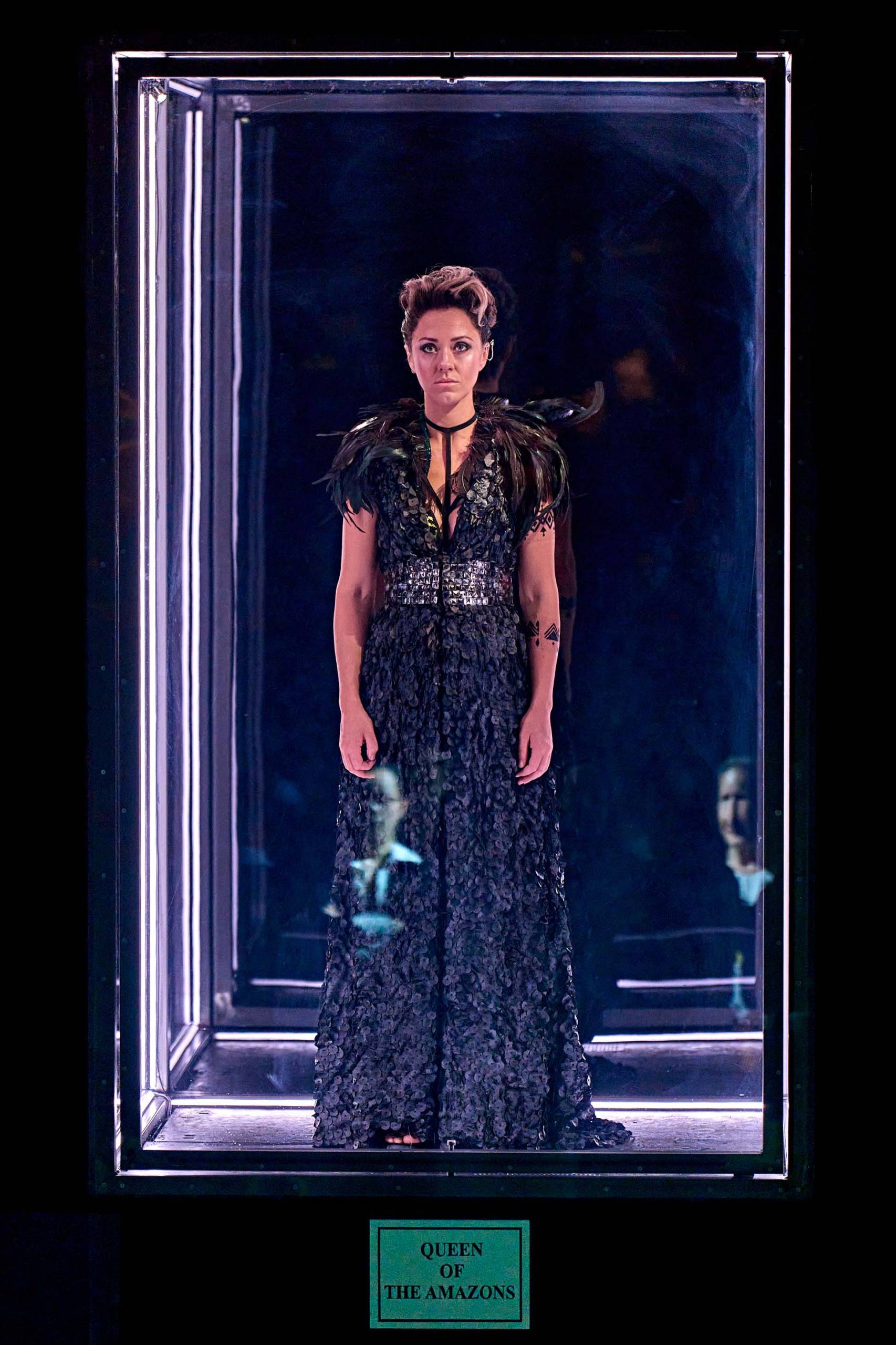
There are other things about the production which mystify me. For example, Hippolyta spends the opening scenes in a glass cabinet. This is all played out as though it was obvious and goes away completely unexplained when the prop is no longer needed. Mmm…
Arlene Phillips is the movement director and has done fine work with the fairies5 who are presented as acrobats and dancers. They spend part of the time hanging from the ceiling, part on raised parts of the stage.
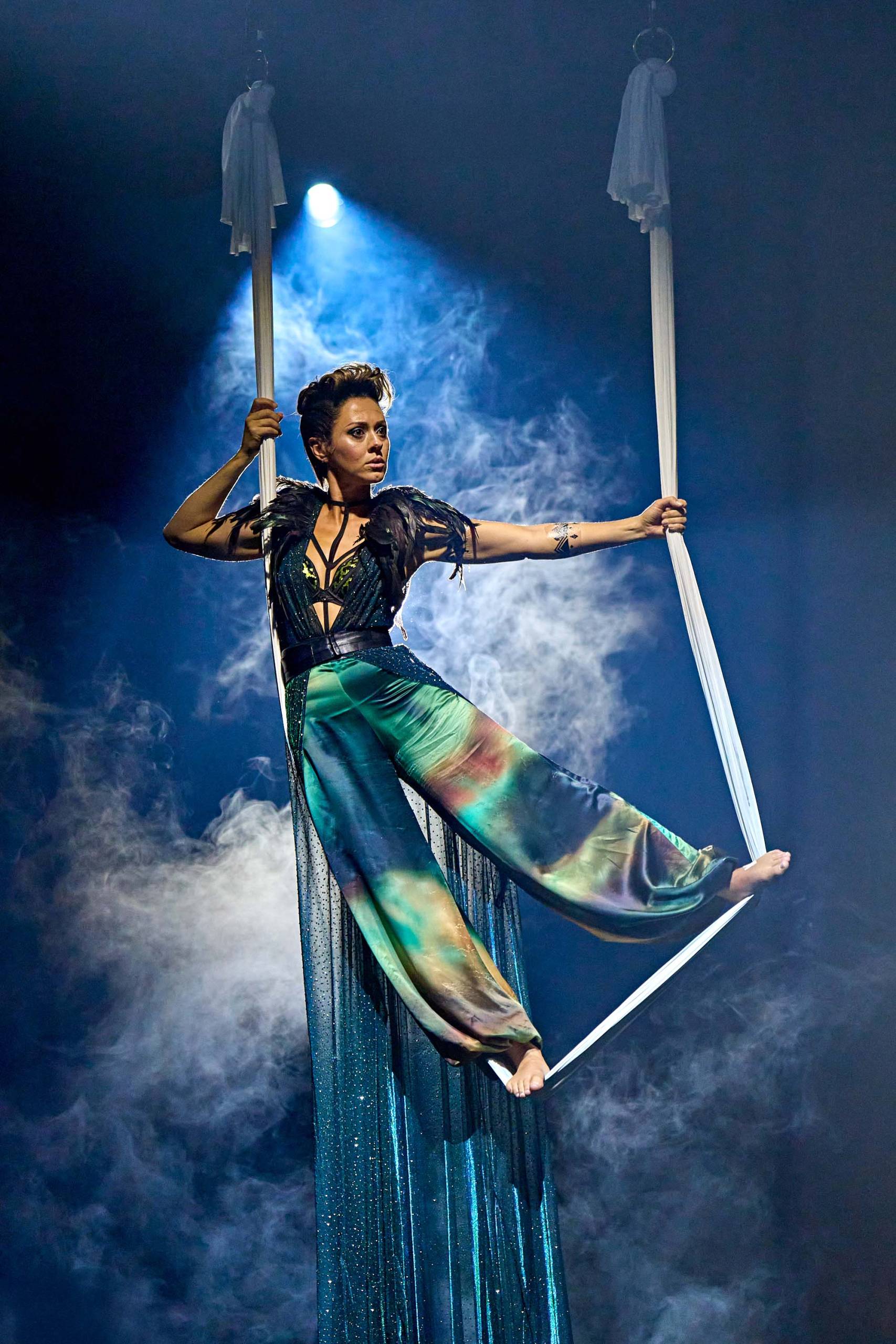
Now, this is the factor. If you are coming to this play for spectacle, movement, effervescence, energy, humour and the rest then you will go away a very happy audience member indeed. It is exciting and entrancing in that regard.
If you are coming to see a Shakespeare play, then a lot of the play is buried beneath the movement and the text is twisted hither and thither to make it unrecognisable.
The cast, including the Mechanicals6, and the four lovers lost in the forest7, all do well with the direction they have been given by Nicholas Hytner, but the director takes way too many liberties in getting this play to the direction it reaches – indeed, lost in a forest..

Most audience members will leave the theatre happy and entertained, Children and teenagers will be thrilled by the more salacious moments.
I just wonder how Shakespeare would feel. Perhaps he would allow himself a giggle before struggling to get to sleep at night.
- Shakespeare Reviews ↩︎
- Review in The Times (UK) ↩︎
- https://twilightdawning.com/2012/08/13/remixed-shakespeare-for-the-hip-hop-generation/ ↩︎
- JJ Feild and Susannah Fielding ↩︎
- Kat Collings as Moth, Ali Goldsmith as Cobweb, Lennin Nelson-McClure as Mustardseed, Bella Aubin as Peaseblossom, David Moost as Puck ↩︎
- Emmanuel Akwafo as Bottom, Hilson Agbanbe as Starveling, Felicity Montagu / Hollie Hales as Quince, Molly Hewitt-Richards as Snug, Jem Rose as Snout, and Dominic Semwanga as Flute. ↩︎
- Nina Cassells as Hermia, Lily Simkiss as Helena, Divesh Subaskaran as Lysander, Paul Adeyefa as Demetrius ↩︎
 twilightdawning