Et Tu, Brute?

Julius Caesar
The Courtyard Theatre, Stratford
3rd September 2009

Tonight, I watched David Troughton in a repeat of the BBC light drama, New Tricks. Troughton is an actor with a distinguished Shakespearean pedigree and he carried off the TV role with aplomb and class.

Continue reading

Winter in Summer

The Winters Tale
RSC at the Courtyard Theatre, Stratford-Upon-Avon
23rd July 2009

The RSC have put together a new ensemble which will work on a number of productions between now and 2011. If these first fruits are anything to go by, it promises to be a very good run indeed.

Continue reading

As We Like It!

Royal Shakespeare Company
The Courtyard Theatre, Stratford Upon Avon

As You Like It
23rd of April 2009

In 2007, Neil Bartlett directed a version of “Twelfth Night” for the RSC which held tightly together in the first half of the performance but tended to be more unwieldy after the interval as the drama led us out into countryside celebrations and a hippy-chic interpretation of some of the songs in the second half. It was bright, colourful but a little too flamboyant for its own good. Watching Michael Boyd’s take on “As You Like It” at the Courtyard in Stratford-Upon-Avon, I began to wonder if this production was going to fall into the same problems. Tight and precisely directed in the city action of the first scenes, a little too wild in places as the action transferred to the forest in later scenes.

Continue reading

New Albums on the Horizon (and an old title just to spice the pot)

Two of the artists I respect most have new albums coming in the next few weeks.

First up is Bob Dylan whose new album is due on cd and vinyl on the 28th of April. I think the artwork is dreadful but I’m sure the musical content will be better. It’s called "Together Through Life"

Next is John Foxx who, as I’ve mentioned before, has been working with Robin Guthrie. Their album will also be on cd and vinyl and will appear the first week in May. It’s called "Mirrorball".

On a more personal note, I’ve been working on remastering the sound on three albums for a band from the 70s and 80s called Sad Cafe. I now have a provisional release date for the first of these. The album also called Sad Cafe will be on Renaissance Records in the States on the 21st of April.

I mentioned John Foxx. Another album he has been busy on dropped through my letterbox this morning. This time he’s worked with Steve D’Agostino and Steve Jansen (ex-Japan). I’ve not shown the artwork for this one before so here goes:

Mr Foxx is frighteningly prolific.

What other discs would I recommend at the moment?

Walter Becker – Circus Money (not just because I was involved in the release of this one)
Alice Cooper – Along Came A Spider (oh, another one I was involved in)
Mostly Autumn – Glass Shadows
Bob Dylan – Tell Tale Signs
Revue Noir (Debut EP – featuring Sam Rosenthal from black tape for a blue girl)
Sam Yahel Trio – In the Blink of An Eye
Rubicks – In Miniature
Frankie Valli – Romancing the Sixties (one for the nostalgists – but very good!)
Marie-Juliette Beer – The Garden
Barclay James Harvest – Revolution Days (just happens to feature Ian Wilson and Mike Byron-Hehir from Sad Cafe, did I mention I’ve been remastering for them)
Bob James – Urban Flamingo
Saviour Machine – Legend 1
Son Volt – On Chant and Strum
Danilo Perez – Panama Suite
Richie Furay Band – Alive (Catch my interview with him on Cross Rhythms on the web and in Natural Progressions Magazine in the world of print)

Enough for now………….

 

A Heavy-Handed and Stormy Tempest

Thursday Night, 12 March 2009
The Tempest by William Shakespeare
RSC Courtyard Theatre, Stratford

Another night with the RSC and another lesson in handling Shakespeare when the director wants to “discover” a flavour of a modern theme in the midst of the script. Janice Honeyman believes that The Tempest will speak powerfully to the world of European Colonialism and African slavery. I believe that her direction and the text’s natural moral direction are at odds with each other and that her insistence on making this idea central to the production may have swamped the play just as badly as Alonso’s ship is swamped by Prospero’s magic.

Continue reading

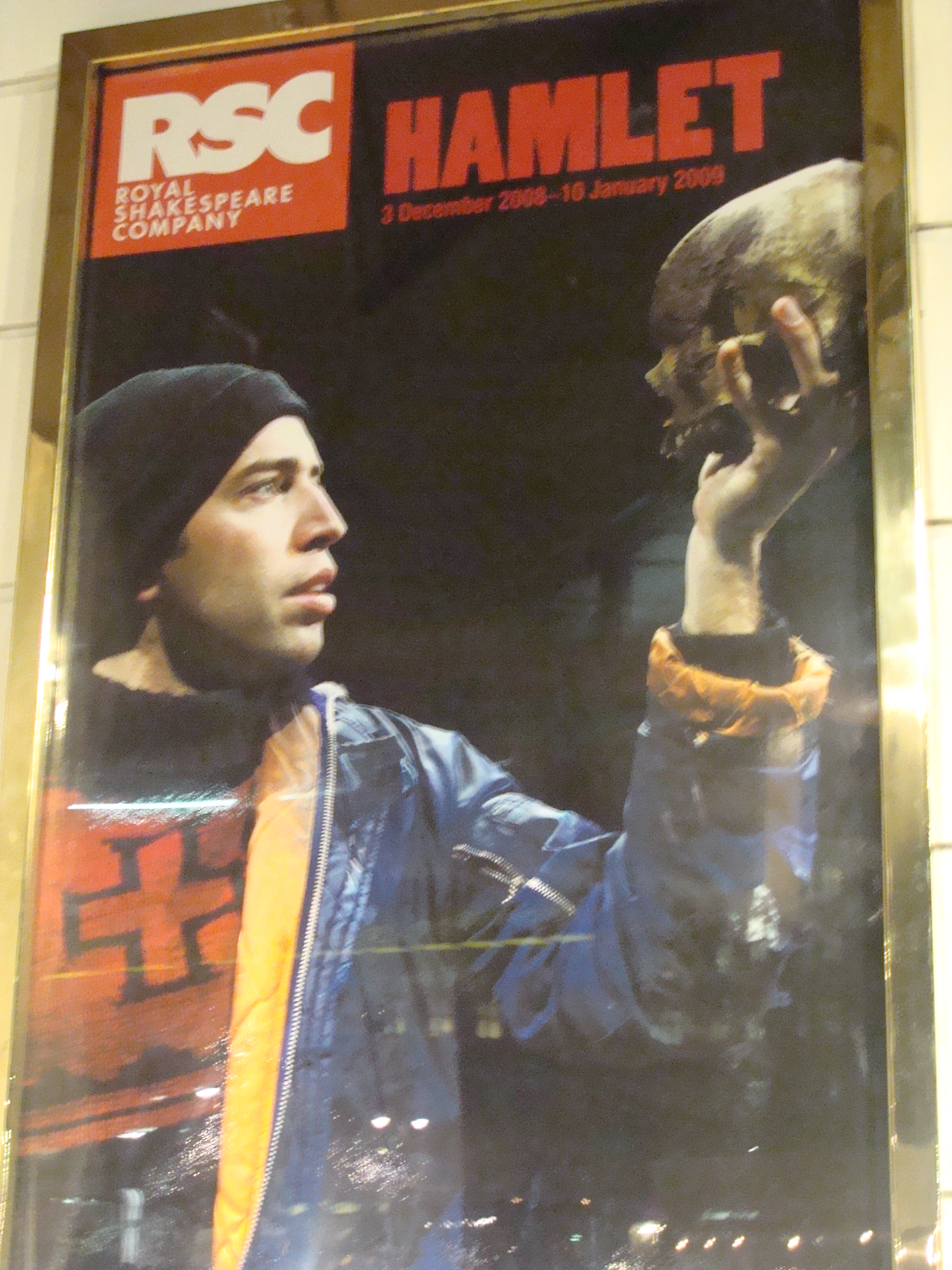
The Play’s the Thing…….

DSC01426


Edward Bennett as Hamlet

In Hamlet, the RSC have, by far, their best production of the year. Last night at the Novello Theatre, an enthusiastic audience rose to their feet in standing ovation to reward the actors on the conclusion of an oustanding performance.

Continue reading

Wherefore art thou, Romeo?

On Friday, I was in Stratford-Upon-Avon, once more, for the Royal Shakespeare company’s latest production of Romeo and Juliet. It has been an interesting year for the RSC with receipts up because of David Tennant’s involvement in Hamlet and Love’s Labour’s lost but some mixed reviews and varying quality and conceptualisation of productions.

Continue reading

Labouring…………….

Love’s Labour’s Lost
RSC
Courtyard Theatre
Stratford-Upon-Avon

30th October 2008

I keep wanting to say that is an ordinary production….. but that isn’t true. In fact, in many ways, the production is extraordinary. The stage design, the colours, the movement are all of a very high standard indeed. I don’t even get to say that David Tennant was either extremely good or extremely bad. His performance as Berowne is run-of-the-mill, no better, no worse, albeit very good in parts.

Continue reading

William, it was really nothing…….

Tomorrow is the first part of my two-legged consideration of David Tennant’s role in the works of William Shakespeare. Any one who reads this journal on a regular basis (there must be someone!) will know that I’m pretty committed to the RSC and try to take in all of their productions. So Thursday, I journey to Stratford-Upon-Avon to see the latest production of the rather slight "Love’s Labours Lost". Then in December on its London transfer I have the rather more substantial "Hamlet". Anyone who follows the papers (tabloid or broadsheet) will know that the good Doctor takes the lead in these two – indeed in Hamlet, he is paired with that other star-crossed traveller, Patrick Stewart. Don’t know what I think about this. I’m not keen on the RSC doing productions where the lead actor outranks the play – even before its opened. When Patrick Stewart works with the RSC normally it barely raises a ripple of interest unless the production is really good so this is obviously about Tennant. I hope by the time I return on Friday, he will have done Shakespeare proud……..

The poor remainder of the Andronici*

*quote from Act 5 Scene 3 Line 130

When I started reading and studying Titus Andronicus I thought I would spend about a month with it – in the end I’ve been working with it for more than double that time. When I started life seemed in a reasonable, steady place. At the moment life seems as bad as it can get. Time moves on but it is now time to put the book to bed.

In Titus Andronicus, Shakespeare has produced a play in which the themes and ideas are timeless. This is remarkable given that at times it has all but lost its audience. Moreover, he seems to have conceived that the themes should have a timeless applicability. I have already talked much in previous journal entries about the fact that the play shows that empires and nations rise and fall with the quality and morality of its people. They are not eternal. Consequently, the pattern of the play casts clear links between ancient Greek myth and the events which it sets in ancient Rome. However, the speakers constantly remind us that they are actors in a later day by the allusions to more contemporary events. This is Shakespeare’s way of showing that any society can fall as its people lose their way. Therefore, the players speak in the manner of people living in Reformation times even though they are ostensibly Romans watching their empire fall to the enemy they have defeated and brought within their walls.
Aaron, the villain of the piece, accuses Lucius (the coming emperor) of having a conscience which carries with it “twenty popish tricks and ceremonies” (5.1.76), a clear allusion to the vanquished Catholicism of Shakespeare’s time. At another point, a Goth explains his late arrival by saying that he “stray’d to gaze upon a ruinous monastery” (5.1.21). The “Romans and Goths” are walking in 16th century England and their fall is one that Shakespeare’s generation is also in danger of.

But what is the nature of this fall? As I mentioned in an earlier entry, the Romans have defeated the Goths at the beginning of the play but only by becoming like them. When Tamora (the Queen of the Goths) begs Titus for the life of her sons, he is deaf to her pleas. They are taken away to be sacrificed to the gods. Rome has lost its humanity and its compassion. 

But life is not simple, the Goth leaders are as bad as they seem. Rome as indeed become like them. Rule cannot simply pass to them. Tamora and her remaining children and fellows are lost in a web of concealment. She loves the evil Aaron but has married Saturninus and proclaimed love for him in order to gain influence in Rome. When her offspring, Chiron and Demetrius are schooled by Aaron (and by extension by Tamora herself) in the idea of raping and molesting Lavinia, they are taught to cover their actions by the cutting out of Lavinia’s tongue and the cutting off of her hands.
But the plotters have overstepped themselves and Tamora gives birth to a baby who is clearly not Saturninus’ but rather Aaron’s. She describes it to her Nurse as a “dismal, black and sorrowful issue” (4.2.66) and the Nurse repeats her words to her lover, Aaron. She suggests that Aaron should “christen it with thy dagger’s point” (4.2.70). There is a lack of humanity in anyone who can speak like this of anyone especially their own child and even the vile Aaron cannot co-operate.

Consequently, the playwright must find a third party to pass the throne to at the play’s conclusion. After an orgy of death in Act 5 Scene 3 (the plays least convincing scene – all the remaining issues of the play are settled just a little too quickly by too many deaths), it passes to Lucius, the surviving son of Titus, who is watched from above by “the poor remainder of the Andronici” as he takes the crown. Ominously, he is watched also by the Goth army who remain silent – perhaps watching how things develop before deciding whether to support or overthrow him.

Ironically, whether the Empire of Rome will stand depends on whether the prominent leaders can regain their humanity and their compassion. Titus’ family departed from this when they sacrificed prisoners from among the Goths foolishly believing that the gods would be pleased with them (again, there are echoes of this in our own day). The new generation must now choose whether or not to hear the plea which Tamora gave at the outset of the tragedy: “Wilt thou draw near the nature of the gods? Draw near them in being merciful”. (1.1.120-121).